
What is the Metaverse, and Why Does It Matter?
How is the Metaverse Changing E-Commerce and Marketing?
Why is Metaverse Safety Important?
What will Consumer Safety & Privacy Look Like in the Metaverse?
How Can We Ensure Metaverse Safety Moving Forward?
On October 28, 2021, Facebook announced the name of its new parent company that would encompass all brands previously owned under Facebook’s name, introducing the public to Meta. Meta was launched in a founder’s letter and introductory video from Facebook’s CEO, Mark Zuckerberg, who talked highly about how Meta (and the Metaverse) would be the next chapter in connecting society through technology.

In Zuckerberg’s introductory video to the Metaverse, monitored by Facebook, the CEO highlighted aspects of what consumers could do when interacting with the Metaverse. Whether it be creating a virtual avatar and interacting with others, making purchases through the new face of E-commerce, or participating in experiences like “traveling the world” and other enticing events that the Metaverse can provide for consumers that are much more convenient than the real world.
However, even after Zuckerberg’s lengthy letter and hour-long introductory video, followed by many Meta-branded videos that explore the vastness of the Metaverse’s potential, people still find themselves confused and asking for more clarity on what the metaverse is. Going beyond understanding what the Metaverse fully entails, Metaverse safety is another highly-discussed topic that remains vague and highly uncertain when moving forward into the digital future.
Between consumer privacy concerns, deep fakes, and silence from Meta when it comes to metaverse regulations, finding more clarity on what the metaverse will provide to its users only scratches the surface of transparency when it comes to learning how Meta’s cyber universe will keep consumers safe.
What is the Metaverse, and Why Does It Matter?
Some people view the metaverse as a new social networking platform, while others may see it as a big tech company or even the entirety of the internet viewed through the lens of an avatar. In reality, the term “metaverse” originated in 1992 from sci-fi novelist Neal Stephenson after he published “Snow Crash,” a novel where characters could immerse themselves in a digital world to escape reality.
So, what does the metaverse entail? Although the metaverse currently exists and interacts with our daily lives, Meta’s rendition of the metaverse is still in the works and, thus, creates a lack of clarity for the details when diving into the evolution of the digital world.
Even though the finalized version of the metaverse is still in the works, we can use the historical patterns and information we already know about the metaverse to provide some more context on the logistics of what comes next.
Let’s start with what the metaverse IS NOT. The metaverse isn’t:
- A new social media platform
While it is true that Meta is building a VR social platform that will be specific to the metaverse, the complete immersion into the metaverse goes far beyond social media and social networking platforms.
- A company or a tech giant
Even though Meta is the top company nourishing the future of the metaverse, with many other companies like Apple and Microsoft investing in it, the metaverse itself is not a company at all but rather the host of the technology that all of the contributing companies are producing.
- The internet through the lens of an avatar
Similar to mistaking the Metaverse for a new social media platform, many often see Meta’s videos that leverage avatars or online gaming platforms, like Roblox that specializes in avatars, and assume that the Metaverse will be an upgraded version of how we interact with the internet through our phones. In reality, while avatars have become the face of the Metaverse and a vast market for E-commerce, the immersive experience of the Metaverse is intended to run much deeper.
With a more precise image of what the metaverse is NOT, we can better understand what it IS, a spectrum of the future of digital technology. In short, the metaverse combines four “realities” to optimize every aspect of a user’s experience. The four elements of the metaverse include:
- Real Life – Our physical day-to-day, the life that exists around us
- Augmented Reality – A mix of the real world with an overlay of virtual elements (think Snapchat filters or Pokemon GO)
- Mixed Reality – Combining aspects from both augmented reality and virtual reality to find a seamless balance between the real world and the digital world
- Virtual Reality – A fully digital world that exists entirely online

Now, the big question: Why does any of this matter?
The development of the Metaverse matters because of how it will disrupt and impact how society works today. Those who interact without the Metaverse in their lives will live entirely differently than those who choose to immerse themselves in the Metaverse. Instead of spending lots of time on smartphones, people who embark in the world of the digital future will be living in the multiple realities that the Metaverse has to offer. The Metaverse will change how we shop, how we interact, how we learn, and even how we develop as human beings.
If the Metaverse develops to the fullest extent that Meta is pushing for, it could entirely change how we experience the internet. Whereas today we interact with a “2D” version of technology, the Metaverse will strive to shift us into the “3D” future of our digital actions.
There are also many confusing buzzwords associated with the Metaverse: unhackable information systems like Blockchain, fungible tokens or digital currencies like cryptocurrency, and digital art forms like non-fungible tokens (NFTs) that also serve as a digital currency. These terms make up the foundation of the Metaverse, but, like the Metaverse itself, many people are still unsure what they truly mean. By interacting with these digital features of the Metaverse, the way we spend our money and store our information starts to change to an entirely new and unexplored structure.
How is the Metaverse Changing E-Commerce and Marketing?
Metaverse commerce will comprise the digital E-commerce structure that provides convenience and fast results to consumers, combined with traditional physical retail that is consumer-centric and provides a more personal feel. In order to get the Metaverse’s commerce efforts in front of potential consumers, the structure of marketing will also have to adjust beyond its traditional and digital roots to keep up with the explosive growth of the Metaverse.
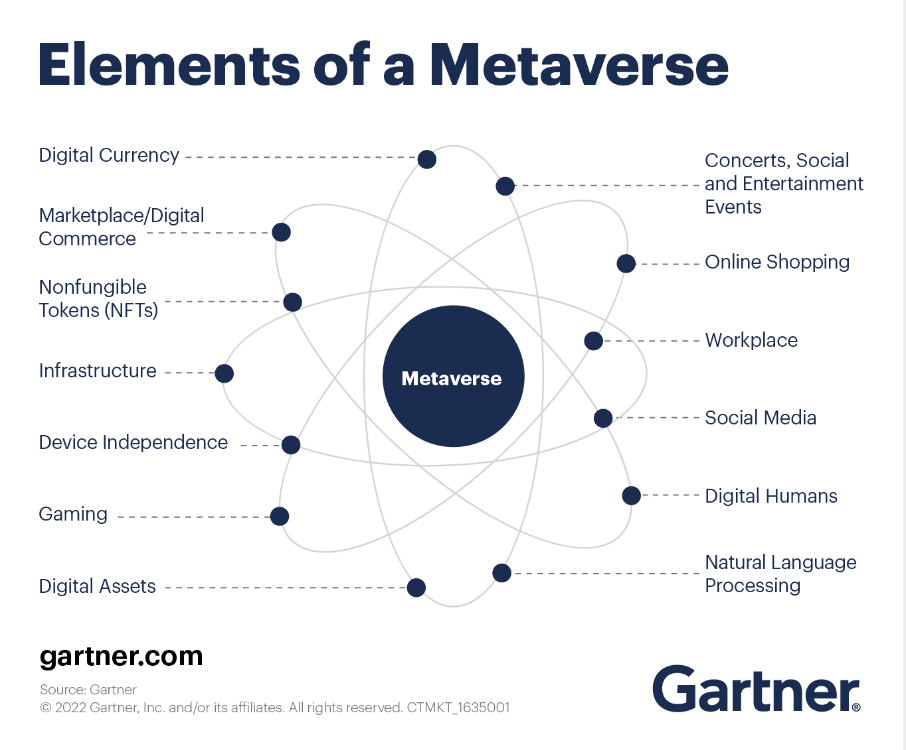
Marketing in the Metaverse must create content that “wow’s” the audience by providing a ferociously unique and hyper-personalized experience without making them feel like their privacy is being compromised. Metaverse commerce and marketing could change how we experience the internet by pushing the boundaries of one reality and leveraging multiple realities in industries such as travel, music, real estate, gaming, education, and many more. Many aspects of the Metaverse are appealing to marketers and businesses, such as the range of different platforms that will implement advertising tactics or the ability to operate in a real-time structure that mimics the timeline of the real world.
The VR industry is anticipated to reach revenues of $6.7 billion by the end of 2022 before skyrocketing to $12.2 billion in 2024, once the Metaverse has a more solidified presence in society. Gamers are also an audience with impressive buying power, especially on digital clothing like “skins” on gaming platforms, with worldwide in-game purchases anticipated to accumulate over $74.4 billion by 2025.
Companies like American Eagle are already capitalizing on the opportunity to monetize from gamers by creating platforms like Livetopia through Roblox, where members can create virtual avatars and dress them in AE’s newest clothing styles – conveniently also available for purchase in AE stores. Gucci is also optimizing its gamer audience, releasing a pair of digital sneakers that can be worn on avatars for $17 and tried on “physically” through augmented reality lenses.
Why is Metaverse Safety Important?
Wunderman Thompson’s 2022 survey revealed that 72% of parents who have heard about the Metaverse and worried about how it will protect their children’s privacy, with 66% of parents being concerned about the safety of their children in the evolution of technology.
Parents are not the only ones worried about privacy and safety concerns in the Metaverse, while discussions about security and data privacy remain undiscussed by Meta and other companies that anticipate holding stakes in the Metaverse. With the new technologies like NFTs and cryptocurrency creating a base for the Metaverse, paired with a potential requirement increase in user data for personal verification, brands need to implement more evolved security measures to alleviate data privacy risks and build consumer trust.
Technological research firm, Gartner, predicts that a quarter of people will spend at least one hour per day on the Metaverse in 2026 for shopping, work, education, or entertainment. With the anticipated hyper-personalization that the Metaverse will provide consumers, brands must find a balance between providing personalized experiences without crossing boundaries in terms of consumer privacy.
In most cases, consumers don’t mind sharing their personal information for in-person experiences and online since laws and regulations are already in place to protect personal information and data privacy. For example, parents worried about their children’s safety in the Metaverse feel safer in online environments with regulations like the Children’s Online Privacy Protection Act. However, the logistics of Metaverse safety regulations remain uncertain.
Going beyond the average personal information that we provide in-person and on the internet, the Metaverse and VR technology are capable of collecting much more from consumers, including things like VR goggles that can find patterns in eye movement and sensors that can collect bodily movements.
Metaverse safety is essential for consumers, especially with the need for hyper-personalization, because many questions remain unanswered about who has ownership over a user’s personal data, what can be obtained, and what information will be shared with other entities.
What will Consumer Safety & Privacy Look Like in the Metaverse?
Metaverse safety for consumer privacy is a top priority for in-person experiences and social media platforms, though many people are unsure how these will be addressed in the Metaverse. Even with rules and regulations in place, it is still common to see things like doxing, cyberbullying, scams, and unethical practices on the internet – if the Metaverse does not set any boundaries to protect consumers, it will either dissuade consumers from participating or create an environment for criminal and unethical activity to run rampant.

Many aspects of the Metaverse need to be secure before launching to the public. The social engineering of the Metaverse can lead to massive data breaches if not properly coded – especially with personal data and financial information. Although Blockchain is advertised as an unhackable information storage system, the downside is the uncertainty behind what happens if the data is intercepted or does not have clear ownership.
Another conflict with Metaverse privacy laws comes from the Metaverse’s lack of clarity and structure because it is still in its early development stages. Different countries have different rules and regulations regarding advertising, data privacy, and consumer safety on the internet. The lack of structure in the Metaverse can also create conflicts through differing regulations based on each country and loopholes businesses will find to avoid the consequences of invading consumers’ personal information and privacy.
While there is a clear standard of laws and regulations for consumer safety and personal data on the internet, the Metaverse safety standard is still heavily undefined and a topic that Meta and other Big Tech companies have not yet discussed. However, there are many areas that we can already identify that need to be addressed to ensure that businesses will enforce Metaverse safety and protect their consumers in the digital world.
How Can We Ensure Metaverse Safety Moving Forward?
Meta remains silent about how it plans to address Metaverse safety and data privac, though more issues continue to arise about the topic. The main issue with ensuring ethics in the Metaverse is that it goes beyond Meta and is governed by many sources, including country-wide and business-specific regulations. In order to make sure Metaverse safety is a top priority and is framed in a consumer-centric way, many sectors will need to be on the same page.
There will need to be many partnerships between businesses, investors, government bodies, and even public/private institutions in order to adequately address the potential dangers of the Metaverse and how to activate impactful solutions.
Of course, there is no doubt that many of these entities will disagree on how to address the issue of personal information, data storage, and privacy in the Metaverse. However, by kick-starting the conversation, these entities can begin discussing what potential solutions could look like, even if they are not universal. Based on the available information on the Metaverse and concerns that users have for how Metaverse safety will be a top priority, several areas can already be identified to implement more structure and potential regulations to create a solution:
- Implementing Rules & Regulations
First, implementing a structure that includes rules and regulations can be vital to avoiding many ethical dilemmas in the Metaverse, especially if they are based on behaviors already forbidden on the internet and in-person events. This could create a sense of community guidelines that users must follow to continue using the Metaverse.
Instead of countries creating guidelines for Metaverse safety, the regulations can be put in place universally by industry leaders or by specific businesses with the understanding that they will not reach their full potential and audience if they do not have standards and regulations in place, especially by creating boundaries that marketers can not cross. Users should also be able to report marketers or other users for abusive behavior or making them feel uncomfortable so that individual issues can be addressed and consumers are aware that their voices are being heard – ultimately creating a safer environment in the Metaverse.
- Ensuring Penalties for Harmful Actions
Creating penalties may be more difficult in the virtual world compared to the real world. Still, it may be necessary for marketers or users who attempt to create a potentially harmful environment in the Metaverse. Again, deciding what is deemed ‘harmful’ and necessary for punishment depends on the entities coming together and regulating the Metaverse, which may be an inconclusive conversation – although it could also yield some productive results. By at least voicing these concerns so that the overseeing entities are aware, they can begin to ideate a solution together and decide what actions they can take on an individual level.
- Permitting Full Anonymity in the Metaverse
Users should have complete control over what data they can share in the Metaverse regarding their personal information for data storage. However, with the amount of data anticipated to be needed from users in the Metaverse, users should not be able to have total anonymity.
With the anticipation of being fully anonymous, users would be more inclined to be unethical and participate in harmful behavior – like identity theft, harassment and threats, data breaches, and criminal activity – while concealing who they truly are. Where technology like VPNs are available on the internet to hide user identities, VPNs should either be modified or not allowed on the Metaverse to prevent full anonymity.
Finding a balance between protecting personal privacy in the Metaverse and preventing full anonymity is crucial as it allows users to have the Metaverse safety they are eager to have while dissuading them from being unethical.