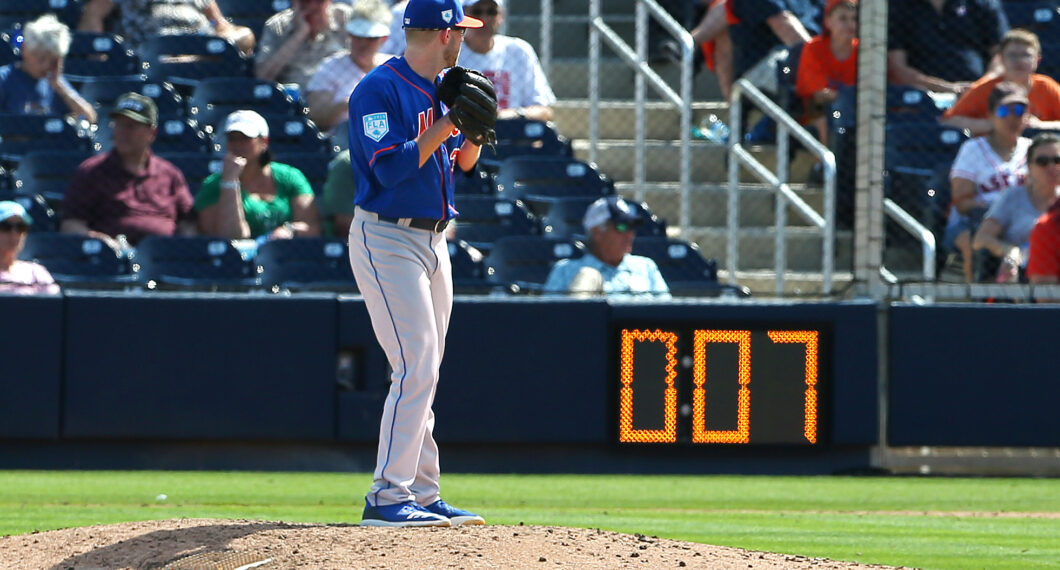
The baseball pitch clock is arguably the most influential rule change in the history of the game of baseball. Some of the other influential rule changes the MLB has implemented over the years have been drug testing, instant replay, and the elimination of collisions at home plate. However, none of these are nearly as influential to the gameplay as the pitch clock. The baseball pitch clock is extremely controversial with goals of shortening games, speeding up gameplay, and speeding up pitchers and hitters’ routines prior to each pitch.
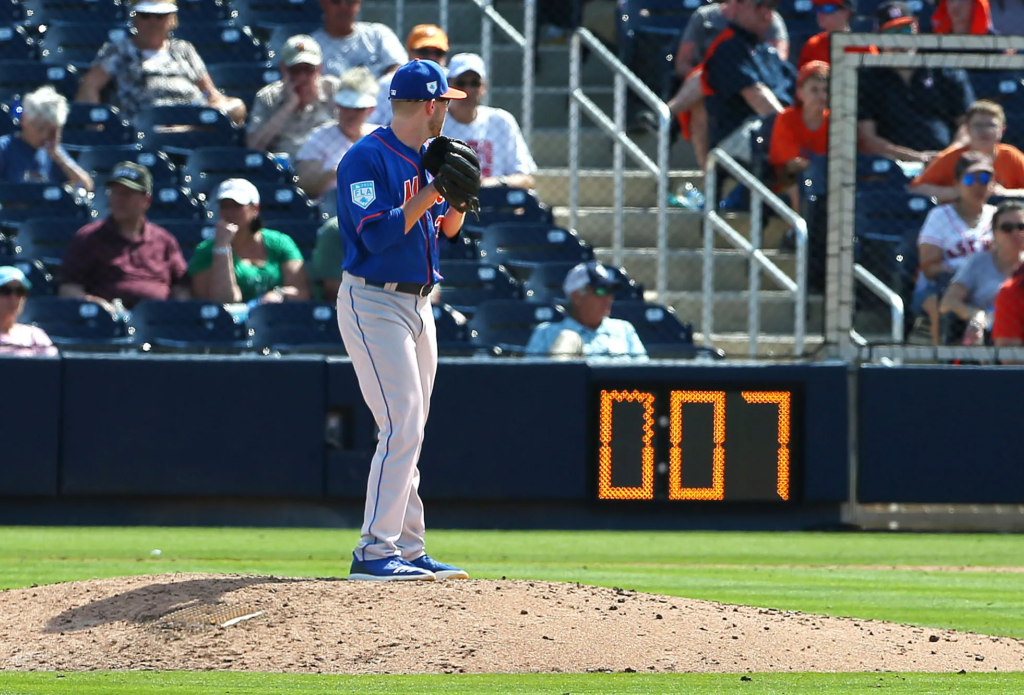
What we’ll cover
- History of the Baseball Pitch Clock
- Pitch Clock Violations
- Baseball Pitch Clock in the MLB and NCAA Baseball in 2023
- Baseball Fans and the Pitch Clock
History of the Baseball Pitch Clock
Unlike the other three major sports in the US (hockey, basketball, and football), baseball has never had a clock dictate the gameplay. However, due to the newly implemented pitch clock in 2023 in the MLB, that long standing tradition has been changed. Part of the uniqueness of baseball since its origin has been the routine of each pitcher and hitter between innings, at-bats, and pitches. In the last few years, there has been a shift in the game though favoring a faster paced, shorter length version of baseball in hopes of retaining fans and increasing interest in the sport.
According to FanSided, the rule was first tested and implemented in minor league baseball in 2015. The Double-A and Triple-A leagues that enforced the rule saw an increase in the pace of play by 26 minutes. In 2022, the average length of a nine-inning MLB game in was three hours and three minutes. In spring training this year, MLB games have been down to just two hours and thirty-eight minutes. But is that what baseball fans and players really want?
Pitch Clock Violations
Now that you understand the baseball pitch clock’s history, what does it really mean for the players involved and for the game as a whole? This demo from MLB.com demonstrates the pitch timer used in the Minors in 2022 versus the same amount of pitches in a Major League Baseball game without the timer. The rules are stated in the MLB Rules Glossary:
“In an effort to create a quicker pace of play, a 30-second timer between batters will be implemented in 2023. Between pitches, a 15-second timer will be in place with the bases empty and a 20-second timer with runners on base.
- The pitcher must begin his motion to deliver the pitch before the expiration of the pitch timer. Pitchers who violate the timer are charged with an automatic ball. Batters who violate the timer are charged with an automatic strike.
- Batters must be in the box and alert to the pitcher by the 8-second mark or else be charged with an automatic strike.
- With runners on base, the timer resets if the pitcher attempts a pickoff or steps off the rubber.
- Pitchers are limited to two disengagements (pickoff attempts or step-offs) per plate appearance. However, this limit is reset if a runner or runners advance during the plate appearance.
- If a third pickoff attempt is made, the runner automatically advances one base if the pickoff attempt is not successful.
- Mound visits, injury timeouts and offensive team timeouts do not count as a disengagement.
- If a team has used up all five of its allotted mound visits prior to the ninth inning, that team will receive an additional mound visit in the ninth inning. This effectively serves as an additional disengagement.
- Umpires may provide extra time if warranted by special circumstances. (So if, as an example, a catcher were to be thrown out on the bases to end the previous half-inning and needed additional time to put on his catching gear, the umpire could allow it.)”
As you can see, there is a lot to digest, and that’s the same reaction many of the players had this year as it was implemented:
Baseball Pitch Clock in the MLB and NCAA Baseball in 2023
Not only has Major League Baseball implemented the baseball pitch clock, but the NCAA has also began enforcing it in the 2023 season. The rules are similar to the MLB’s, as stated in the NCAA rules:
“Under the rule, with runners on base, a pitcher will be required to start the motion of throwing a pitch or making a pickoff throw to avoid a clock violation.
Pitchers will be allowed one step-off or fake throw to a base per batter to reset the clock.
If a defensive player requests and is granted a timeout by an umpire, it would be treated the same as a step-off by the pitcher to reset the clock. Again, this will be allowed only once per batter.
If the 20-second clock expires without a pitch or pickoff throw being made, a ball will be added to the count.
Previously, pitchers received a warning for the first violation of the 20-second clock, and a ball was added to the count for any subsequent violations. Pitchers could make an unlimited number of step-offs or fake throws to reset the clock.
If the offense violates the 20-second clock, a strike still will be added to the count.”
I asked a Division I Baseball Head Coach about his thoughts on the baseball pitch clock. He said, “I like the idea of the pitch clock, but I think it is over-enforced… When someone is taking too long, it’s noticeable and can be addressed without making it a bigger deal than it needs to be… I also feel that umpires are gonna become more enemies with fans, teams, and coaches than they already are.”
There have been suggestions in the media about “turning off” the pitch clock after the 6th inning and in playoff games, which the NCAA Coach said he would like to see if there is going to be a rule change.
Baseball Fans and the Pitch Clock
Finally, it is most important to evaluate how baseball fans feel about the baseball pitch clock because after all, that is who the MLB and NCAA are looking to cater to. As a baseball fan for my entire life, even though I have heard others talk about how baseball can be “hard to watch” due to how slow it is, I have never found that to be the case for me. Part of the beauty of baseball, from its beginning, is the fact that there is no clock, like all of the other major sports have. There is a flow to the game of baseball that is present from youth baseball all the way up through the major leagues.
What are your thoughts on the baseball pitch clock? As a baseball fan, or not as a fan, does it affect the amount of games you will attend or watch in 2023? Leave your thoughts and questions in the comments below!