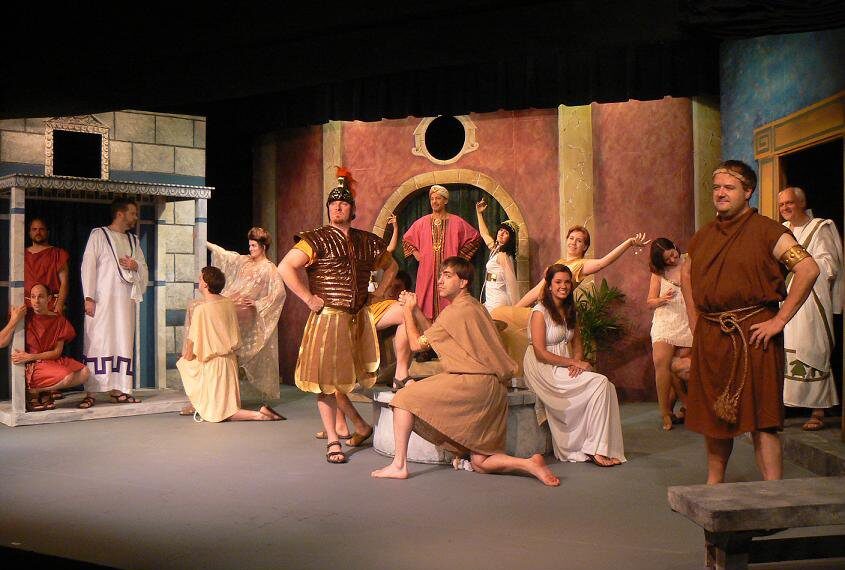
Have you ever wondered how a play or show comes together? That’s where stage management comes in. It’s not magic! It takes a lot of hard work, and someone has to keep everything organized. You might think the stage manager just holds a script, but there’s so much more to it. I am going to be sharing my first-hand experiences on a musical that I am currently stage managing (Spring 2025) called “I Love You, You’re Perfect, Now Change”. It is a four-person musical with extensive songs, dances, character changes, quick costume changes, set and scene changes, as well as a great deal of blocking (i.e. an actor’s movement during a scene on-stage). Now, let’s dive into the real world of stage management and see what it takes to bring a show to life!
Scheduling and Conflicts
Blocking and the Script
Props, Costumes, and Scene/Set Changes

Stage Management – Scheduling and Conflicts
Imagine you have a bunch of friends, and you need to plan a big party. Everyone has different schedules, and some people might not get along. That’s kind of like what a stage manager does! You’re the planner, the organizer, and sometimes, the peacekeeper. The scheduling and conflict resolution aspects of stage management are crucial to a successful production.
Creating A Schedule:
First, you help create a schedule for rehearsals. You work with the director and actors to find times that work for everyone. You make sure everyone knows where they need to be and when. This can be tricky, especially when people have other jobs or school! You might need to send out daily or weekly call sheets, which are like detailed timetables, to keep everyone informed. You must anticipate problems before they arise. What happens if an actor is sick? You must have backup plans, and be ready to adapt. For this show, we couldn’t rehearse in the space where we were going to perform the actual show until the week of opening. This left an added challenge of making sure that I could work alternative rehearsal locations into the schedule around everyone else’s conflicts. First, I read through the entire script, one page at a time, and made a detailed list of which characters enter and exit at which points throughout each scene. From this data, I was able to create what I call a “Contingency List”. This list tells me (and the other directors) which pages or scenes we can work on certain nights where a cast member has a conflict or is sick. I have provided an example below in bold type:
Act 1
Scene 1: Cantata for a First Date – Boys (2-3), then Girls (3), then All (3-5).
Scene 2: Busy – Isabella and Jesse (Whole Scene)
Scene 3: Stud and Babe – Matt and Randi (Whole Scene)
Scene 4: The Two Bobs, then Cause I’m A Guy – All/Girls (15-19), then Boys (19-21)
Scene 5: Tear Jerk/Movie Scene – Isabella and Jesse (Whole Scene)
Scene 6: Lasagna/I Will Be Loved – Matt and Randi (24-27), then Randi (27-28)
Scene 7: Parents/Hey There – All (Whole Scene)
Scene 8: Satisfaction – All (Whole Scene)
Scene 9: I’ll Call You Soon – Randi (33-34), Add Boys (34-35), Add Isabella (35-36)
Scene 10: Scared Straight – All (Whole Scene)
Scene 11: Wedding Part 1 – All (Whole Scene)
Act 2
Scene 1: Wedding Part 2/Bridesmaid – Matt and Randi (43), then Isabella (44)
Scene 2: Baby Scene – Matt and Randi and Jesse (45-51), then Jesse (51-52)
Scene 3: Sex and the Married Couple – Matt and Isabella and Others/Offstage (Whole Scene)
Scene 4: Driving Scene – All (Whole Scene)
Scene 5: Waiting – Isabella and Jesse (60-61), Add Matt and Randi (61-63)
Scene 6: Who Are You/Less in Love – Jesse and Randi (63-64), Matt and Isabella/Sitting (64)
Scene 7: Rose Ritz – Randi/Long Monologue and Matt/Video Operator (Whole Scene)
Scene 8: Funeral – Isabella and Jesse (Whole Scene)
Scene 9: Finale – All (Whole Scene)
| NO ISABELLA | NO MATT | NO RANDI | NO JESSE |
| I.2 | I.2 | ||
| I.3 | I.3 | ||
| I.4 (19-21) | I.4 (19-21) | ||
| I.5 | |||
| I.6 | I.6 (27-28) | I.6 | |
| I.9 (33-35) | I.9 (33-34) | I.9 (33-34) | |
| II.1 (43) | II.1 (44) | II.1 (44) | II.1 |
| II.2 | II.2 (51-52) | II.2 (51-52) | |
| II.3 (OFFSTAGE) | II.3 (OFFSTAGE) | ||
| II.5 (60-61) | II.5 (60-61) | ||
| II.6 (ONE LINE) | II.6 (63-64) | II.6 (64) | II.6 (64) |
| II.7 | II.7 (ONE LINE) | II.7 | |
| II.8 | II.8 |
Dealing with Conflicts:
Then, you have to deal with conflicts. Sometimes, actors might have a disagreement about how a scene should be played, or maybe there’s a problem with the set. You listen to everyone and help find solutions. You’re like a detective, figuring out what’s wrong and making it right. You are also the timekeeper, making sure everyone is on the same page, and that time is used efficiently. You may also need to be a mediator, helping people communicate effectively. For example, on the week of March 17th, one of the four actors was sick with no voice for both Monday and Tuesday. This meant that I had to quickly and efficiently create an alternate schedule of scenes to rehearse (based on my “Contingency List” as I showed above). In addition, our normal rehearsal space was booked for that Monday the 17th, so there was an added monkey wrench. First, group texts with just the cast, with just the directors, with just the production staff, and with everyone involved is going to be a huge help in keeping your communications organized and traceable! In this instance, I texted the directors to get their input on whether they still wanted the sick actor at the rehearsal, and if not, if they had any preferences on what we work on while he is out. From there, I used my “list” to come up with a completely new schedule for the entire week, and texted the new weekly schedule out to absolutely everyone involved. This was a schedule that focused Monday and Tuesday on scenes without that sick actor AND also not having our normal rehearsal space, and then on a longer, more loaded itinerary for Wednesday (where we had to focus on vocals and choreography) and for Thursday (where we had to focus on only acting). On the actual nights of rehearsal, while it is still up to the directors to tell me when they feel satisfied that a song, dance, or scene has met their expectations, I had to keep things moving and keep everyone focused on the task at hand as we now had a plethora of scenes to cover in only a short time. My phone, acting as my clock, was never out of sight. You have to make sure you have a good understanding of time and the prioritization of scenes/musical numbers, or you’ll never get done all that you need to get done to be prepared for the following weeks. This kind of flexibility and problem-solving is a core component of successful stage management.
You have to be super organized! You keep track of everything in a prompt book. This book has the schedule, notes about the show, and contact information for everyone involved. It’s like your stage management bible! You might also use digital tools, like spreadsheets or specialized software, to keep track of everything. The goal is to make sure every detail is documented.
Stage Management – Blocking and the Script
The Vital Master Script:
The script is the story of the show. It tells the actors what to say and do. But how do the actors know where to stand and move? That’s called blocking, and you help keep track of it.
You watch the director work with the actors, and you write down where they move on the stage. You use special symbols and abbreviations so you can remember everything. Abbreviations include: “US” for upstage or away from the audience, “DS” for downstage or towards the audience, “L, C, R” for stage left (this is audience right), center, and stage right (this is audience left) respectively, “X” for crossing (this is an actor’s deliberate movement on the stage, e.g. “Jim X’s DSR of couch” = Jim crosses downstage right of the couch).

You make sure the actors are consistent, so they don’t change their movements from one rehearsal to the next. This requires close attention to detail, and a good memory. If an actor changes a movement, you must note it, and communicate it with the director. For this show, I bought a dozen sharpened pencils, so that I could keep track of the blocking and choreographed movements. ALWAYS use a pencil because blocking and choreography is going to change! This meticulous note-taking is a key responsibility of effective stage management.
The Constant Changes of Blocking:
You also keep track of any changes to the script. Sometimes, the director might want to cut a line or add a new scene. You make sure everyone has the updated script, so there are no surprises. You are the one who makes sure that the script is followed, and the show is consistent. You must also be able to communicate these changes clearly and efficiently.
You’re like a human memory bank! You remember every detail about the show, so you can help the actors and crew whenever they need it. You are also a communicator, ensuring that everyone knows what is happening.
Stage Management – Props, Costumes, and Scene/Set Changes
Keeping Track of Props and Costumes:
Props are the objects actors use on stage, like a cup or a sword. Costumes are the clothes they wear. Scene changes are when the set changes from one scene to another. You help manage all of these things! For this musical, the director and I sat down for an hour and went scene-by-scene to go over every single costume change, set change, and prop addition and subtraction. When I am in the performance space, it will be my job to determine what is the most efficient way to keep all the costumes, furniture, and props backstage, so that myself and my stage crew can easily move things on and off the stage between scenes without taking too much time or making too much noise. Great stage management is about being able to optimize the backstage of the rehearsal space effectively.
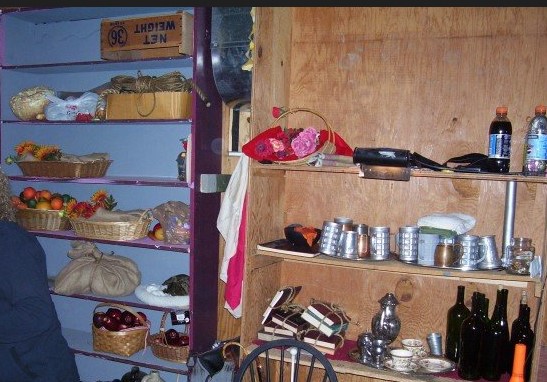
You make sure all the props are in the right place before each rehearsal and performance. You check that the costumes are clean and ready to go. You work with the crew to plan scene changes, so they happen smoothly and quickly. This requires careful planning and coordination. You must anticipate potential problems, such as a prop breaking or a costume needing repair. You are also the one who ensures that everything is placed back in its correct place after each performance.

You might have to help find or make props and costumes. You might even have to help fix them if they break! You’re like a handyman, a fashion designer, and a magician all rolled into one. You might have to research historical periods for accurate costumes, or build a prop from scratch.
“Calling” The Show with Scene and Set Changes:
You are the one who calls the cues during the show. You tell the lighting and sound operators when to make changes. You tell the crew when to move the set. You make sure everything happens at the right time, so the show runs smoothly. I will be honest here, as I have done backstage work on a lot of shows. It is very rare in community theatre at least for the stage manager to “call” a show. I’ve usually been way too busy doing quick costume changes, moving props from place to place, changing set pieces on-stage, and cuing the actors backstage or in the green room (this is the theatre term for a backstage area where actors go between scenes). In my experience, the lights, the sound/microphones (if any), and box office have far more autonomy in community theatre.
The Real Magic
Being a stage manager is hard work, but it’s also a lot of fun! You get to work with creative people and help bring a story to life. You get to solve problems and make things happen. You’re like the conductor of an orchestra, making sure everyone plays their part. You are an essential part of the creative team.
You’re not just holding a prompt book; you’re holding the show together. You’re the glue that keeps everything from falling apart. You’re a problem solver, a communicator, and a leader. You are the one who ensures that every performance is the best it can be.
If you love being organized and helping others, stage management might be the perfect job for you. So, next time you see a play or show, remember the stage manager. They’re the unsung heroes who make it all possible.