Record Your Monthly Income
Record Your Monthly Fixed Expenses
Record Your Monthly Variable Expenses
Total Your Monthly Income and Expenses
How to Effectively Use Your Budget
This article will outline how creating a monthly budget can be done is 4 easy steps. It will be simple to follow and allow you to make better financial decisions. Whether you are trying to figure out where your paycheck is going, or how to save for something you have always wanted, this process will allow you to answer these concerns! I will include pictures with each step to make it easier to follow.
Creating a monthly budget is a vital process to help you identify how you can reach certain financial goals. There are a variety of major purchases that you may want to save for such as a car, college, vacation, or a new house. Learning the simple steps to create a monthly budget will help you better visualize how it will be possible to attain these goals! Creating a monthly budget will also help you identify what you are spending your money on. This will allow you to assess what expenses you are willing to cut out in order to meet your desired financial goals.
1. Record Your Monthly Income
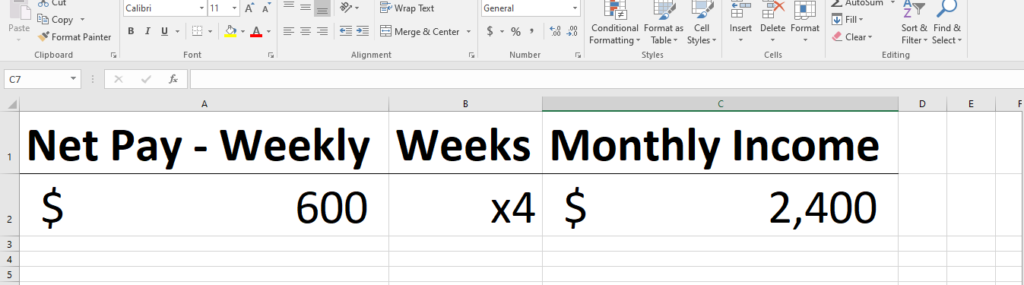
The first step in creating a monthly budget is to determine your monthly income. It is important to use your net pay and not your gross pay since the net pay is what you will actually have to spend. If you are paid WEEKLY, take the Net Pay amount on your paystub and multiple by 4. If you are paid BI-WEEKLY, take the Net Pay amount on your paystub and multiply by 2.
If part of your income is made up of commissions, it is important to include these as well. Commissions can change week to week or month to month. Therefore, you can look back at your previous year’s total commission and also divide by 12 to get an average commission per month. Make sure to include this amount when creating a monthly budget.
2. Record Your Monthly Fixed Expenses
The second step in creating a monthly budget is to determine your fixed expenses. Fixed expenses are those expenses in which the amount is the same each time. It would be very helpful to have your bank or credit card statement out in order to accurately record your fixed expenses. For any annual fixed expenses, make sure you divide these by 12 to get the monthly amount you should include in your budget. For any other fixed expenses that do not occur monthly, make sure you convert them to monthly for the purposes of creating a monthly budget.
Fixed expenses include:
- Mortgage / Rent
- Utilities (Gas, Electric, Water, Internet, Cable)
- Car Insurance
- Car Payments
- Child Care
- Student Loans
- Taxes – City, Town, School
- Subscriptions

3. Record Your Monthly Variable Expenses
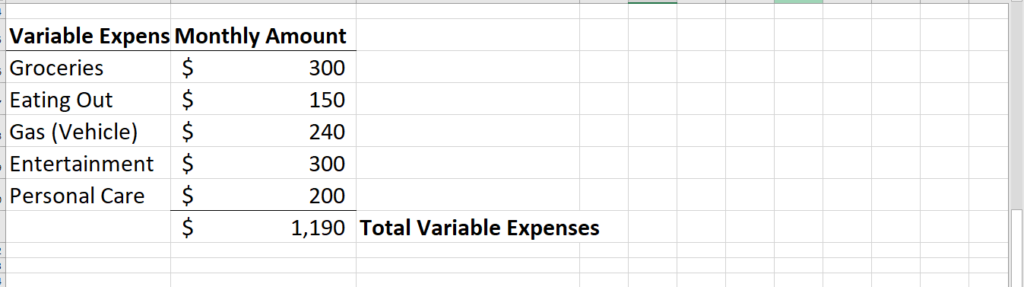
The third step in creating a monthly budget is to determine variable expenses. Variable expenses are those expenses that are not the same every month and can fluctuate each month. It would be very helpful to have your bank or credit card statement out in order to accurately record your variable expenses. Since these change from month to month, it may be necessary to take a look at the last few months and record the average of what you spend per month.
Variable expenses include:
- Groceries / Food
- Gas for Vehicle
- Entertainment
- Personal Care
4. Total Your Monthly Income and Expenses
Once you have categorized and recorded your monthly income and expenses, you must total each. This will allow you to see if you are spending more that you make or if you have income left over. Spending more than you earn during a month is clearly not sustainable. Therefore, it is necessary to take action quickly to cut any unneeded expenses before your head feels more underwater.

How to Effectively Use Your Budget
As you can see, it is simple to create a monthly budget when following these steps. Learning this process will help you to constantly adjust your budget and visualize your current financial position during any point of your life. By using your budget, you can identify expenses that are problematic. You can use this information to research ways where you can cut back your spending on these particular expenses.
You can use your monthly budget to set future spending limits on variable expenses that you do not necessarily need. This will help you have a goal in mind in order to save additional money. For example, you may set a spending limit on eating out of $125 per month. Throughout the month, you can keep track of the amount you spend on eating out to make sure you are sticking to your predetermined spending limit. This takes some discipline, but will lead to additional savings to reach your desired financial goal.
Finding small monthly savings can add up over the course of a year! Imagine being able to cut back on some streaming subscriptions which saves you a total of $50 per month. Over the course of a year, it will free up $600 which can be put towards your savings goal! For more information on a rule of thumb for budgeting strategies/tips, see this article which discusses the 50/30/20 rule.
Following these steps to create a monthly budget will give you the knowledge needed to make better financial choices when it comes to spending and saving money. This monthly budget is an essential piece of information to help you take financial action. The next step is to adjust your spending habits where you can in order to save additional money. This requires discipline, discipline, and more discipline! However, you will soon be able to see the benefits in your bank account!