
- Habits are Hard to Change/Develop
- Strategic Introductions to New Opportunities Are Critical for Emerging Leaders
- Team Building – A Hidden Gem with Dual Purposes
- The Book
Synopsis: Your employees need more momentum and leadership skills, right? You pursue enhancements and updates for digital devices and leaner processes. Why aren’t you doing the same with your employees? Steps to develop leadership skills in employees are only a click away. Increasing your team’s leadership skills is a great longevity/contingency strategy. Leadership has various forms. Some leaders manage people. Others manage projects, and some focus on specialized topics of which they are deemed Subject Matter Experts. If you are a manager of people, a proactive effort to analyze their ambitions and progress must be in place. Additionally, strategies to address less outspoken employees who might not raise their hand to do things outside of their primary responsibilities will ensure everyone has the opportunity to grow. Leadership does not have to mean a title change. Leadership also includes taking ownership of a project, leading others to learn a subject, taking ownership within the workspace, and collaborating more effectively. Employee leadership skill development is as essential as taking mandated courses. Leaders understand the following:
-How to work with varying personalities.
-How to develop leadership skills in employees holistically.
-How to manage time more effectively.
-How to deal with pressure and adversity.
-How to create development plans.
Leadership skills also garner confidence. Having confident employees is a product of developing their leadership skills.

Habits Are Hard to Change/Develop

Developing employees to become leaders is essential for any organization’s sustainability and contingency strategies. Some individual contributors are fully satisfied with staying within a defined set of responsibilities. Going above and beyond the scope of one’s role may be scary for some. A combination of these factors can discourage employees from pursuing leadership opportunities.
Memories, emotions, and pattern recognition are vital to forming habit-making behaviors. Structuring employee leadership skill strategies should involve activities that include these factors. A budding employee’s experience when attempting something new will gravely impact their ability to develop a new habit. If you manage employees ready for advancement, work tactfully to curate development experiences they enjoy. Following these steps is how to develop leadership skills in employees.
Strategic Introductions to New Opportunities Are Critical for Emerging Leaders

Strategic introductions to new opportunities can promote development within a team. Small steps towards progression can influence employees to try new things. Although progression will occur at different rates, employees who successfully enter a unique opportunity or role will encourage growth amongst their peers. Social Proof, a term that Robert Cialdini coined, is the idea that people will mimic or emulate the actions of others around them. Remember your childhood when a friend influenced you to try an experience? Similarly, seeing peers advancing might influence others as well.
Performance reviews are a great time to nudge employees to take their contributions to the next level. If an employee is meeting expectations, encouragement to expand their contributions can be a modest way to steer them onto a leadership trajectory. For example, if you have an employee who has perfected a process, maybe you could challenge them to teach it to another person, give a training presentation, or even task them to provide an improvement suggestion.
In your working space, how can employees see new leadership opportunities? Is there a formal effort only, or can anyone be exposed to a leadership path at any time? Providing webinars, special speaker series, learning path recommendations, and panel discussions exposes your employees to great resources supporting their development. Be careful to curate content for both full-time and contract talent.
More importantly, emerging leaders won’t flourish at the hands of a leadership team who themselves do not pursue development opportunities. Leaders must set an example for emerging leaders. This is how to develop leadership skills in employees overall.
Team Building – A Hidden Gem with Dual Purposes

For compliance reasons, your organization might not allow potato sack racing as a team-building exercise! However, strategically curating quarterly team-building exercises that leave a lasting impression is a sure way to develop leadership skills in employees. Step away from your professional daily routine. Remember a structured activity in your life that you now consider a core memory. I will help you with this process. You may have gone on a school trip, participated in an interesting academic group project, participated in a group excursion on one of your vacations, or planned an event with a few people. These activities all involved leadership and aren’t typical routine endeavors. This is why you remember them! Imagine inserting a well-thought-out event where your employees had to complete an exciting task together. Team building should be done in an interesting way for all stakeholders and not forced. This is how to develop leadership skills in employees because it bridges everyone together in a memorable activity. It could even be as silly as seeing which group of employees can recreate a stock photo! During this process, the skills and communication exchanges will brew leaders and strengthen bonds within your team.
Team building exercises include cross-training, group learning sessions, suggestion forums, and general discussions (I like to call them corporate powwows). Budding leaders need to feel like they are a part of the grand scheme of things. Including everyone at the table routinely supports the development of leadership skills in employees holistically. Early in my career, I had a director who took time almost daily to walk around the entire department and check in with people. Team building isn’t only peers working cohesively to tackle a task; it is also leaders co-mingling with their subordinates to develop a mind frame shaped by leadership involvement.
The Amazon Kindle Book
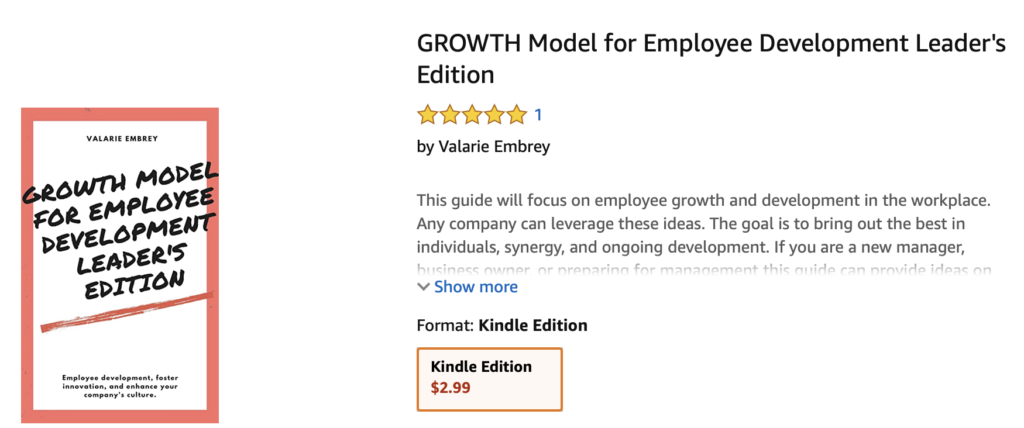
A few years ago, I was referred for a position that would have been my first manager role. During the interview, I did well in answering questions. However, the last question was about leadership. The hiring manager asked how I would try to develop employees in this position if offered the role. I fumbled this question partially due to my insecurity and fear of having no management experience. That night when I went home, I wrote a six-page guide on developing employees’ leadership skills. I didn’t get the role, but this exercise evolved into my self-published book. I plan to re-write it and expand on things I’ve learned since 2013, when I originally wrote the guide.
Thanks for reading my article. Share in the comments any tips you found helpful from this post. Please provide any additional tips regarding how to develop leadership skills in employees below too!
Val