
Set Goals
How Much Should I Save?
When is it Right to Spend?
You may have heard the saying, “There is no such thing as a free lunch.” In a world of rising inflation and soaring costs, spending money responsibly has never been more important. Everything has a cost associated with it, and the earlier you can understand the importance of saving money and spending responsibly, the better prepared you will be in the future stages of your life. As a young professional who has recently been in your shoes, this is what I wish someone had taught me when I was your age.
Picture this: you are a teenager and recently started your first job. You receive your first paycheck and are eager to buy yourself something new. Maybe you want to buy the latest video game or some new clothes. While it is important to celebrate life’s milestones, such as collecting your first paycheck, it might not be the best idea to go spend it all at once. This article will provide you with tips and tricks to get control of your finances from the get-go and to manage your spending in a responsible manner.
Set Goals
Before you make a plan to control your spending, it is important to set goals for yourself. Setting goals gives you something tangible that you are working towards and gives you that extra motivation to not burn your paycheck the second you receive it. But for teenagers and young adults, it might be difficult to think several years into the future when you are going to be making your first major purchases. These purchases might include your first car, your first house or apartment, or even your college tuition bill. It is important to prioritize your wants and needs and to understand that your are going to be making some of these larger purchases at some point in the future. It is hard to think about these things when you are still in high school, but trust me, you will be thankful that you did.
When setting goals for yourself, it is important to be realistic and to take it seriously. Are you likely to actually buy a brand new sports car or build a brand new house straight out of college? If you are like most people, the answer is no. But when you do graduate college, you might want to get your own place to live, whether it be an apartment or a house. It is not realistic to create a budget for your monthly rent payments five or six years into the future because you do not know what the average rent will be that far into the future. But the fact that you are even thinking about this means you are ahead of the game and will be better prepared than most people your age.
As a teenager, these major purchases are likely long-term goals for you. Let’s talk about short-term goals that you should consider. The point of this article is not to say that you need to save all of your money and not spend anything. That would be nearly impossible! The whole point of budgeting and setting goals is to ensure that you have the means to accomplish your long-term goals while also enjoying your life today and being prepared for life’s unexpected costs.
Some of your short-term goals might be saving up for a concert you want to go to or a spring break trip you want to take with your college friends. Spending money responsibly does not mean only spending your money on needs. Instead, it means not overspending on your wants. Go to the concert, take the spring break trip, make memories with friends. But set a limit for yourself and hold yourself accountable for not passing that limit.
How Much Should I Save?
There is no single answer to this question. There are several factors that contribute to how much you should be saving. Your goals play a role in this, but there is so much more to think about, too. There is a principle that every young adult should learn about when first making a budget and learning how to spend responsibly: “Pay Yourself First.”
Pay yourself first essentially means you are investing in your future self. This includes your long-term goals but it also includes investment accounts and, yes, even your retirement account. You’re probably thinking I’m crazy talking about retirement when you haven’t even graduated college yet, but understanding how investments grow and how beneficial it is to put some of your paycheck directly into a retirement account now might change your mind. If you save $2,000 per year starting at age 15, you will have $10,000 saved when you are age 20. If you invest that $10,000 into a retirement account, that $10,000 will be worth over $400,000 when you turn 65.
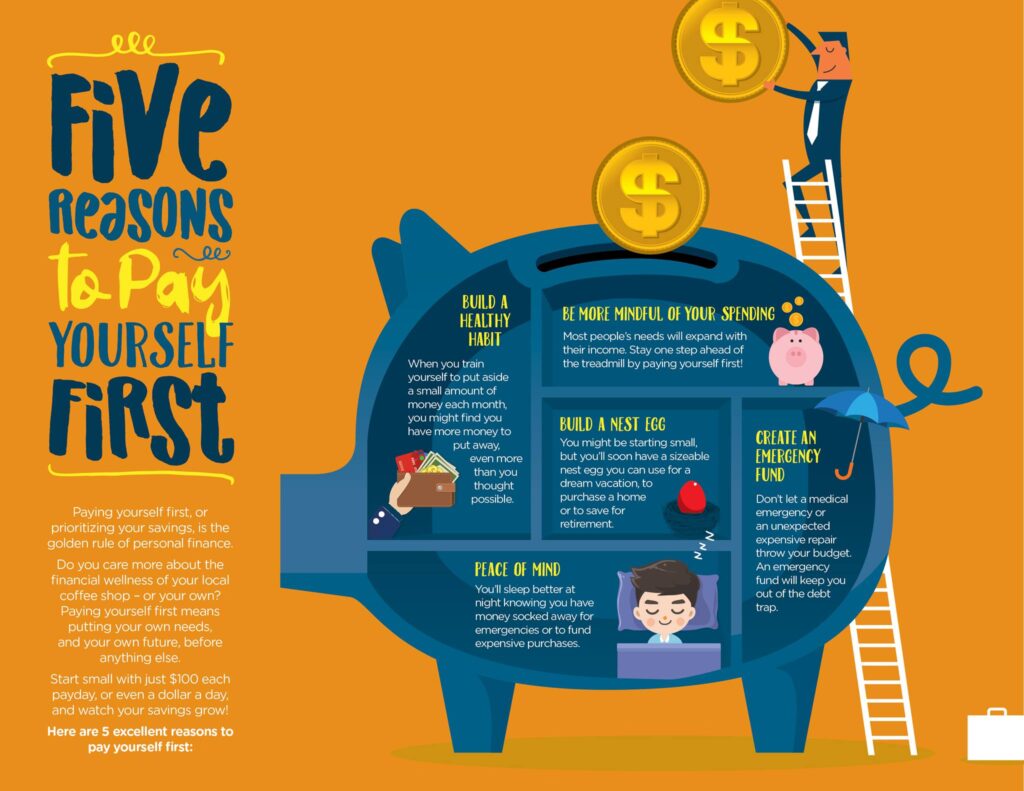
You are the only person that knows your personal situation, but I would encourage you to save as much as you can. As a general rule, you should be saving at least 10-20% of your take home pay. Many teenagers, however, should be able to save even more than that because you do not have as many living expenses, including groceries, insurance, and housing.
A simple way to save without even knowing it is to have your employer do it for you. Most employers pay their employees through direct deposit and allow employees to divide a percentage of their earnings to be deposited into separate accounts. Determine the percentage of take home pay that you can save and have your employer deposit that percentage into a separate savings account. Deposit the remaining pay into a checking account, and you are already on your way to paying yourself first!
When is it Right to Spend?
Spending money responsibly is about understanding your needs versus your wants and finding the right balance to ensure that you are not overspending and under-saving. As a teenager, you likely have fewer expenses than you will have once you are older. But that does not mean you can’t learn how to properly budget now so that you are equipped to spend your money responsibly in the future. A classic budgeting rule is known as the 50-30-20 Rule. Under this rule, you divide your income in the following way:
- 50% to needs
- 30% to wants
- 20% to savings and reducing debt
The 50-30-20 Rule helps you to divide you expenses between wants and needs. But your list of wants is probably longer than your list of needs. I’d like to offer a piece of advice that I once heard that opened my eyes to spending responsibly:
“Your wants are unlimited but your money is limited.”
We all know that spending is inevitable, but setting goals and having a plan in place before you spend money can help to ensure that you spend your money wisely and responsibly. Don’t overspend, but also don’t force yourself into only spending money on your needs. In his Financial Geek blog, Noel Moffatt highlights 11 ways to spend your money wisely, such as buying used items and budgeting your spending.
Spending money responsibly is one of the best habits you can develop at a young age. Investing in yourself today will be beneficial to your future self and will set the sky as the limit for what you will be able to accomplish. Develop your plan, stick to it, and you will be well-prepared for your future expenses.