

In today’s fast-paced economy, many people find themselves asking: What is Financial Wellness and why is it important? While the Investopedia definition often centers on “meeting all of your financial obligations,” true financial wellness is much more than a bank balance. It is about “future freedom” and “option power.” It is the feeling that your past choices are giving you a thumbs up today, and your choices today are opening the doors for you tomorrow. As a woman navigating the “sandwich generation”—balancing the needs of teenage children while supporting aging parents—I’ve learned that wellness is the key to building a life that isn’t just rich, but resilient.
The Sandwich Generation: Navigating “Financial Leakage”
Today, I find myself in the heart of the “sandwich generation.” I am balancing the needs of my 12 and 14-year-old teenagers while simultaneously helping my parents, who are in their 70s, navigate the complexities of trusts and asset protection. According to an AARP report, the pressures of caregiving can significantly impact one’s long-term financial security. This generation is uniquely prone to what I call “financial leakage.”

When you are pulled in two different directions—funding a child’s college dreams while ensuring your parents are cared for—it is incredibly easy to neglect your own “future freedom.” You become the financial shock absorber for everyone else, which often leads to emotional and financial exhaustion. To better navigate these daily pressures, it’s essential to implement practices to manage mental health and stress. Because of our focus on financial wellness, however, the conversations I have with my parents are rooted in empathy rather than anxiety. When money is working in the background, you can be fully present in the foreground. Wellness gives you the emotional space to lead with your heart because the logistics are already secured.
Why “Financial Leakage” is a Silent Threat
Financial leakage is the “silent killer” of future freedom. It isn’t usually one large expense; it’s the tiny drips—$50 here, $100 there—that eventually drain your own retirement bucket. In the sandwich generation, leakage often takes two forms:
- The Emotional Subsidy: Giving “just a little more” to a teen or a parent because of guilt, without checking if it compromises your own “Pillar 4” (Future Freedom).
- The Time-Money Tradeoff: Losing income or career momentum to manage caregiving schedules without a structured financial plan. Bankers Life notes that without strategies for 2026, these hidden costs can derail even the best-laid plans.
The 4 Pillars of a Fireproof House: Your Action Plan
When people ask, “What is Financial Wellness and why is it important?“, they often overlook the protective element of money. Most people use their finances to put out fires—paying off sudden bills or handling emergencies as they arise. True financial wellness, however, is using your money to build a fireproof house.
This concept became a sobering reality for my family when my uncle suffered a stroke in his 50s. Despite being a successful small business owner, the lack of a protective legal and financial structure meant he lost his business, his home, and his assets within months due to medical expenses. To prevent this, I recommend organizing your “Option Power” into these four pillars:
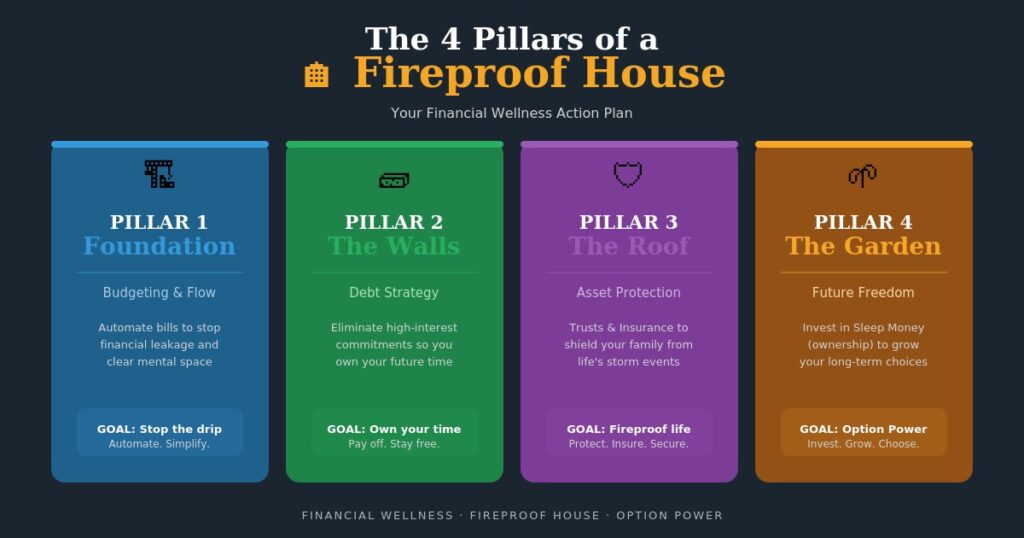
A critical part of the “Roof” (Asset Protection) is understanding tools like Health Savings Accounts. If you’ve ever wondered, “Can I withdraw money from a Health Savings Account?”, knowing the rules can help you protect your assets while managing medical costs for your family.
My Journey: Trading the NYC Commute for “Option Power”
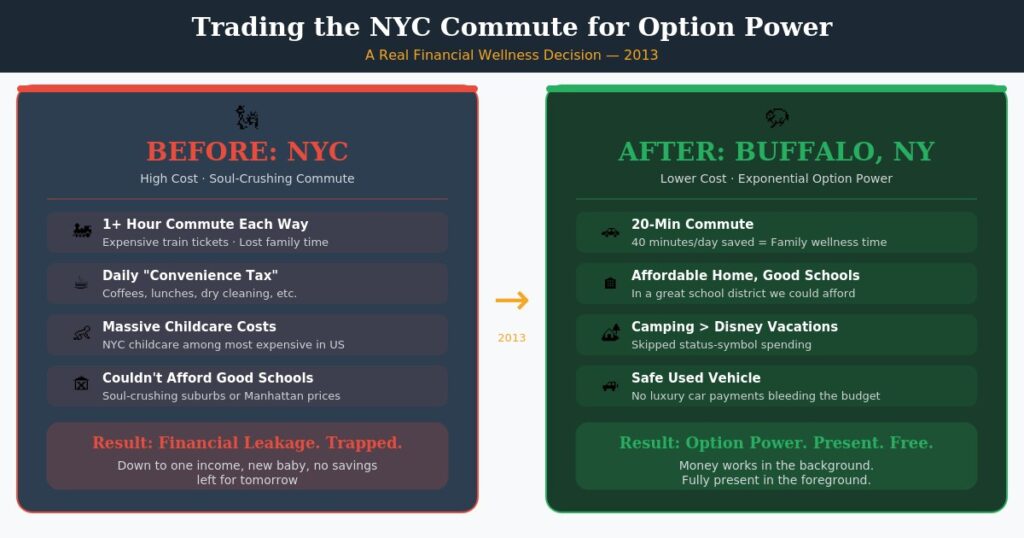
My commitment to this ‘fireproof’ philosophy started in 2011. Working full-time in banking, commuting over an hour each way into NYC with a newborn and a single income, I faced a choice: keep climbing the ladder while bleeding money on train tickets, childcare, and the Manhattan convenience tax — or pivot. In 2013, we made the radical call to move to Buffalo, NY, and it changed everything.

The move wasn’t easy — no family nearby, a new city, a fresh start. But it exponentially expanded our “Option Power.” We could afford a home in a great school district, my husband’s commute dropped from an hour to 20 minutes, and we traded status-symbol vacations for camping trips. That 40 minutes saved every day wasn’t just time — it was wellness.
That decision answered, for me personally, what financial wellness is and why it is important — it is the quiet confidence that your money is working so you don’t have to choose between your family and your future.
Teaching the Next Generation: Ownership Over Consumption

To ensure my children achieve long-term financial wellness and avoid the “financial leakage” trap, we use two “unconventional” rules:
- The “Share” Rule: If my kids want trendy sneakers or AirPods, they can buy them—but they must also buy a share (or a fractional share) of that company. This shifts their mindset from being a consumer to being an owner.
- The “Hours” Rule: I’ve taught my daughter to stop looking at price tags in dollars and start looking at them in hours. If leggings cost $100 and she earns $10 an hour babysitting, is that item worth 10 hours of her life? Usually, the answer is no. This math turns a purchase into an emotional trade-off, which is much more powerful than a lecture.
Frequently Asked Questions (FAQs)
If you’re still asking what financial wellness is and why it is important, these questions are a great place to start.
Q: What is the difference between financial wellness and financial literacy?
A: Financial literacy is knowing the definitions (what is a stock? what is a bond?). Financial wellness is doing—it is the behavioral habit of using that knowledge to create a life of choices. You can be literate but still unwell if your debt is locking you into a job you hate.
Q: How does the “Sandwich Generation” impact long-term financial health?
A: It creates a “squeeze” where your prime earning years are consumed by the needs of others. Wellness in this stage requires building a “Fireproof House” (Protection) so that a crisis at the “top” or “bottom” of the sandwich doesn’t collapse your own retirement.
Q: Can you achieve financial wellness on a low income?
A: Yes. Wellness is about the gap between what you have and what you owe. By focusing on “Option Power”—even if it’s just saving $5 a week to avoid a predatory payday loan—you are taking the first step toward ownership and future freedom.