This article will first cover the various youth sports benefits that are must-know and essential. These four essential youth sports benefits will be broken down and explained thoroughly. It is information that all parents, coaches, youth, and spectators need to be aware of these benefits, to be able to ensure that these benefits are being met for the well-being of our youth. Then, this article will cover the various issues and myths surrounding youth sports. There are a lot of misconceptions out there that I will aim to dispute.
Table of Contents
Benefit 1: Physical Health
There has been an increase in childhood obesity over the years. The prevailing trend more and more kids have stopped playing organized sports, which likely has been exacerbated by the COVID-19 pandemic. If this trend continues, more and more of our youth will suffer from poor cardiovascular and metabolic health, while also having a higher chance of contracting a chronic disease like diabetes, high blood pressure, or high blood cholesterol due to inactivity. Sports in a vacuum will provide opportunities to expend a lot of energy, promote a healthier lifestyle to get better at the sport and expose youth to the necessary training that is key to having the proper conditioning in order to compete. Athletes get bigger, stronger, and faster as they train and compete to become the best they can be, which has a positive correlation with their health status not only at their present age but as they grow up as well.
Benefit 2: Mental Health
Another youth sports benefit is all that sports does for the mental health of our youth. Sports have passed down many lessons to all who play, and there is much to be learned from playing the game. More and more youth today suffer from mental health issues. In a recent study conducted, it was found that “Nearly 7.7 million children and teens in the country – about one in seven – have at least one treatable mental health disorder”. With this alarming statistic only increasing, more needs to be done in terms of trying to help our youth conquer the everyday battles that they endure. Sports can serve as a beneficial way to try and unburden some of our youth through means of distraction and community.
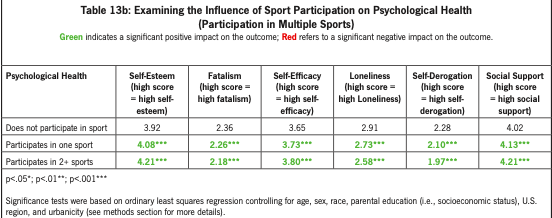
In the figure below, a study done by the Women’s Sports Foundation examined the effects of sports participation on psychological health. Through the information provided, the correlation between self-esteem and participation in sports can be found. Sports provide a forum for athletes to train and get into the best possible physical shape that they can, which can also boost self-esteem in the process. Self-efficacy can aid sports performance and mitigate anxiety, and that only builds with training and preparation. That preparation allows an athlete to feel confidence in their abilities and ensuing performance. Loneliness is an aspect that can be avoided through the sense of community that is cultivated by being a part of a team. A team grows closer together through the shared experiences and time spent together to build real relationships. Social support starts with the coach. Coaches are the pillar for most athletes because they spend so much time with them that at times they can be viewed as a parental figures of sorts. This social support also can be found through parents on the team and in the community as a whole because more help and attention are being given to the team to make sure the athletes have all that they need.
Benefit 3: Emotional Health
The next youth sports benefit that will be explored will be the topic of emotional health. At the end of the day, sports are just a game and there will inevitably be winners and losers. There will always be groups of people that experience two different spectrums of emotions when it comes to the results of the game. Winners would likely feel pride, joy, and excitement among other things, whereas the losing team would likely experience sadness, anger, grief, etc. It is important to feel all of these emotions in life, and sports give athletes a chance to experience all of these. Moreover, sports can serve as an outlet to release frustration or aggression in a healthy manner through a contact sport, or any sport period. Channeling emotions and learning to be disciplined when it comes to how to control those emotions are valuable lessons learned in sports that should not go unnoticed.
Benefit 4: Community and Lifestyle
Sports have the power to bring people together, and this is especially true for youth. Sport is an opportunity for kids to make new friends and expose them to newer communities. These new teammates and even opponents tend to be people in the community or those that attend different schools but are not too far away. Connections and bonds are formed that last due to the time that one spends with their team and teammates. Young people will be able to foster a better sense of community and actively want to interact and engage with those in the community to preserve the bonds created. In addition, sports will have a positive effect on the academic standing of an athlete. As young athlete finds their way into playing sports, there is more of an incentive to maintain their studies to keep being able to play. Sports also teaches an athlete to time manage and schedule appropriately because of the rigor of having to attend school and having extracurricular activities to do afterward that may take away from all of the time they have to study.
Misconceptions & Myths of Youth Sports
Understandably, every parent has fears. These fears could stem from their own experiences or what they have seen or heard in passing, prompting them to be more protective of their child. Here, I will address and dispute some of the more concerning myths out there on youth sports to give parents a new perspective on the matter.
Early Sport Specialization
A lot of parents believe that early specialization in sports is vital to their child’s aspirations of playing at the collegiate, and potentially the professional level. While it is true that specialization can help an athlete in skill development and gain exposure through being one of the better athletes in their age group and class, specialization isn’t the only means to accomplish this. There are many cases where athletes play multiple sports. A notable example is NBA superstar Stephen Curry, who had this to say about his experience playing multiple sports and what it provided him. An important message that Stephen Curry had to say was that playing multiple sports gave him insight as to what he was and was not good at. This allowed him to be able to determine what he wanted to focus on, while also having the chance to experience different things.
Child Needs to Be a Prodigy
Contrary to what it may feel like, your child does not need to be some sort of prodigy to play sports. Sports are ultimately about having fun and youth sports are even more so the focus should be centered on learning as much as possible. It is easy to see how the media latches on to young athletes so early and put a camera in their faces making them the next star, but that isn’t the path for everyone, nor does it need to be. Youth sports have become more of a profitable business, and a great deal of pressure is put on athletes to be the next LeBron James or Serena Williams, and this is what families and athletes should avoid when deciding on whether to play youth sports and who to play for. Remember to have conversations with your child and ask them what their goals are and work out a plan to help them achieve their goals without having to put added pressure on them. When young athletes do receive added pressure to be some sort of prodigy that is when negative health effects start to occur. The best practice is to find a coach and program that aligns with the family’s values, where they will receive instruction and learn to play the right way.
Summary
Youth sports is a growing business, and it is important for all parties (athletes, coaches, parents, spectators) to understand the importance of this time in a young person’s life. They are susceptible to the teachings of those in charge and to their surroundings, meaning that it is just as important to surround an athlete with the right community. The youth sports benefits mentioned are essential to highlight the good that sports can do for young athletes in every facet of their life. Sports is a way to bring people together, and a way to self-actualize into the person that one was meant to be through key teachings of discipline, hard work, patience, teamwork, and determination to name a few.
Resources
https://www.michiganmedicine.org/health-lab/half-us-children-mental-health-disorders-are-not-treated