Breaking Barriers and Building a Nonpartisan Playing Field: Exploring Gender Inequality in Sports and How We Can Make a Difference. In this article we will cover how gender inequality exists today, where Title IX is used thereof, and share a background as to how it began. Oftentimes it can be a struggle with finding ways to create change, but it is quite simple in actuality. In this article, dive into some tips on where to start advocating for gender equality persisting in sports, whether you’re an athlete, coach, trainer, spectator, or none of the above. It is a nonnegotiable that all humans deserve fundamental rights.
What We’ll Cover
Title IX: Here’s What’s Happening
Building an Inclusive Sports Culture
Athlete’s Supporting Athlete’s
Title IX: Here’s What’s happening
Women make up approximately half of the world’s population, and yet, they are often treated as second-class citizens in many areas of life, including sports. Women have faced a long history of discrimination and marginalization, which has led to unequal treatment, lack of opportunities, and limited access to resources in sports.
Title IX is a federal law that was passed in 1972 in the United States, prohibiting discrimination based on sex in any education program or activity that receives federal funding, within sports programs in schools and colleges.
One of the most significant impacts of Title IX has been the growth of women’s sports programs at the high school and college levels. Since the passage of Title IX, the number of girls and women participating in sports has increased dramatically. By 1972, only 1 in 27 girls participated in high school sports but today, that evolved to 2 in 5. in addition, the passage of Title IX allowed women’s sports programs to receive the funding and support that they deserve. Equal opportunities for male and female athletes is a must, and this law did just that.
To put it in perspective, Title IX has also helped to level the playing field for female athletes in terms of resources, facilities, and equipment. Schools and colleges that receive federal funding must provide equal opportunities for male and female athletes, including equal access to coaching, training facilities, and funding.
Despite the progress that has been made since the passage of Title IX, there is still work to be done to ensure that female athletes receive equal treatment and opportunities. Women’s sports programs continue to receive less funding and media coverage than men’s programs. Female athletes continue to face discrimination and harassment today, whether we see it or not, particularly in the form of gender-based violence.
Ensuring equal opportunities for female athletes goes beyond allowing them to play. Here’s an example of how gender inequality persists in sports today, regardless of what may look equal on the outside. Canisius College women’s lacrosse of Buffalo, NY has participated in strenuous volunteer work at the Buffalo Bills concession stands, through Delaware North, on Sundays to fund their program. The men’s lacrosse team, in comparison, does little outside fundraising and year-by-year receives much more money. This example, out of many, has become the norm for female sports teams; working exponentially harder to reach the same level of play as male teams yet still not getting there.
“No person in the United States shall, on the basis of sex, be excluded from participation in, be denied the benefits of, or be subjected to discrimination under any education program or activity receiving Federal financial assistance…”
(Title IX of the Education Amendments of 1972, Section 1681)
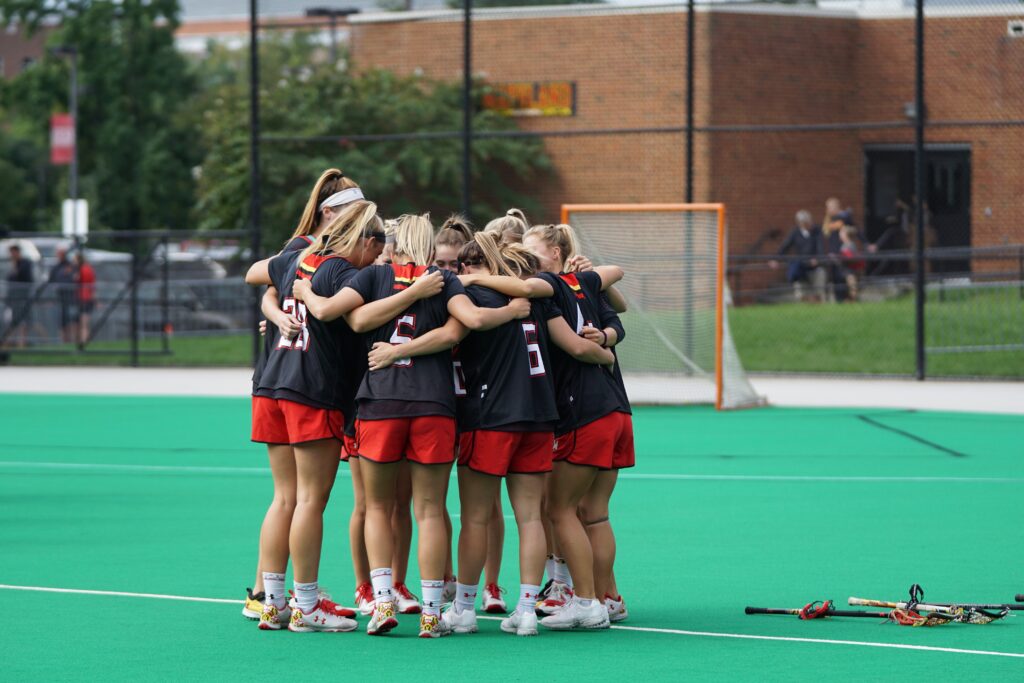
United in Strength: Women’s Lacrosse Players Fight Gender Inequality on the Field and Beyond.
Building an Inclusive Sports Culture
Treating women equally in sports is not just a matter of fairness;
it is essential for ensuring that all individuals have access to the same opportunities and resources. Since gender equality persists in sports, we can help build a world where everyone can thrive and achieve their full potential, regardless of their gender. Whether you are a fan, parent, coach, or staff member, there are numerous ways to make an impact.
Increase Funding
One of the most significant ways to help gender inequality in sports is to provide more funding for female sports programs. This can include investing in new facilities, equipment, and coaching staff to help female athletes excel in their sport. This also could simply mean donating one dollar to your local women’s sports team during their fundraisers. Keep an eye out for social media posts on when teams are participating in ‘Giving Day’, a little goes a long way.
Promote Awareness
Promoting awareness about gender inequality in sports is important and simple. This can be done by starting a conversation, simply. Organizing campaigns and events that focus on gender equality in sports or raising awareness of the issues that female athletes face also have direct impacts. Not only are we better together, but we are powerful when supporting one another and celebrating our differences. Consider reaching out to a local student body member about starting a club or event on your campus or high school.
Increase Social Media Shares
Social Media plays a crucial role in shaping people’s perceptions and visibility of sports by directly impacting the demand of media coverage. Increasing the coverage of female athletes in the media can help to raise their profile, attract more funding, and support for their sports. It is nearly impossible to physically attend local female competitions on a weekly basis, but if media coverage and social media audiences increases, fans are more likely to support a team. From here, awareness grows and we’re off to a good start.
- Re-share female sports’ successes on social media
- Interact with social media posts
- Promote gender equality in sports on socials
Educate yourself
Educating oneself and those around you about the barriers and challenges that female athletes face, and the importance of gender equality in sports, is a huge stepping stone. Reading about the history of women’s sports, following organizations that promote gender equality in sports, (such as ‘Play It Forward’ listed below), and engaging in discussions with others about the issue. By becoming more informed and raising awareness, we can help to break down stereotypes and promote positive change.

Challenge Stereotypes: See Something, Say Something
Stereotypes about gender and sports can hold back female athletes. It’s important to challenge these stereotypes and promote the idea that both men and women can excel in any sport they choose to participate in. Do not be afraid to say something when you see something. Discriminatory language and behavior in sports will stay common if we stay silent. How gender inequality persists in sports starts with us.
Be a Role Model
Any person can be role models for young girls and women by participating in sports themselves and encouraging girls and women to participate in sports. Another tip would be to mentor young female athletes and help them develop their skills and confidence by helping out at camps and organizations at local sports complexes or schools.
Encourage Female Leadership
Encouraging and supporting female leadership in sports is important. This can include having more female coaches, referees, and sports administrators, as well as creating mentorship programs to help female athletes advance in their careers. From personal experience, for instance, strength and conditioning coaches are primarily male which puts a subconscious stereotype that men are superior in the weight room.
Athlete’s Supporting Athletes: Leading the Charge
Male athletes play a pivotal role in putting an end to the stigma that women are inferior in sports, and the first step is to educate them. As a female athlete myself, I’ve noticed that male athletes attend Title IX events less frequently than their female peers. Despite the fact that all colleges are required to have a Title IX coordinator, it’s the female athletes who seem to be more supportive and understanding of its purpose. By promoting knowledge expansion among male athletes, they too will come to understand and support the mission of gender equality in sports.
But raising awareness alone is not enough. We must all come together to effect the changes needed to end gender inequality in sports. Athletes, in particular, are at the forefront of the issue and play a crucial role in driving action. However, they cannot do it alone. Supporting each other and listening to personal experiences are essential to speeding up the shift towards gender equality in sports and making it more efficient. Let us stand together, athletes and non-athletes alike, and create a world where everyone has equal opportunities to pursue their dreams, regardless of gender.
Time for Change
Today, gender inequality is still persistent, although it has decreased tremendously. Ultimately, as long as all humans have access to the same treatment and access to the same opportunity, our world is a much easier place to succeed! We can counter this simply by coming together to strengthen, foster, and mentor one another. Leading ourselves to raising more awareness while limiting the inequalities is a great step in the right direction for women in sports.
It is important to remember that we have already come along way on this journey in creating a more equitable, equal world in many aspects. We continue to rise and anything you do, big or little, counts! By taking these steps, we can begin to challenge gender stereotypes and promote a culture of gender equality in sports. Ultimately, this will benefit not only women athletes but society as a whole by fostering a more inclusive, equitable, and impartial world.