- History of Roe v. Wade
- Rights under Roe v. Wade
- Challenging Privacy Laws
- Abortion Laws by State
- How to Help
- Resources
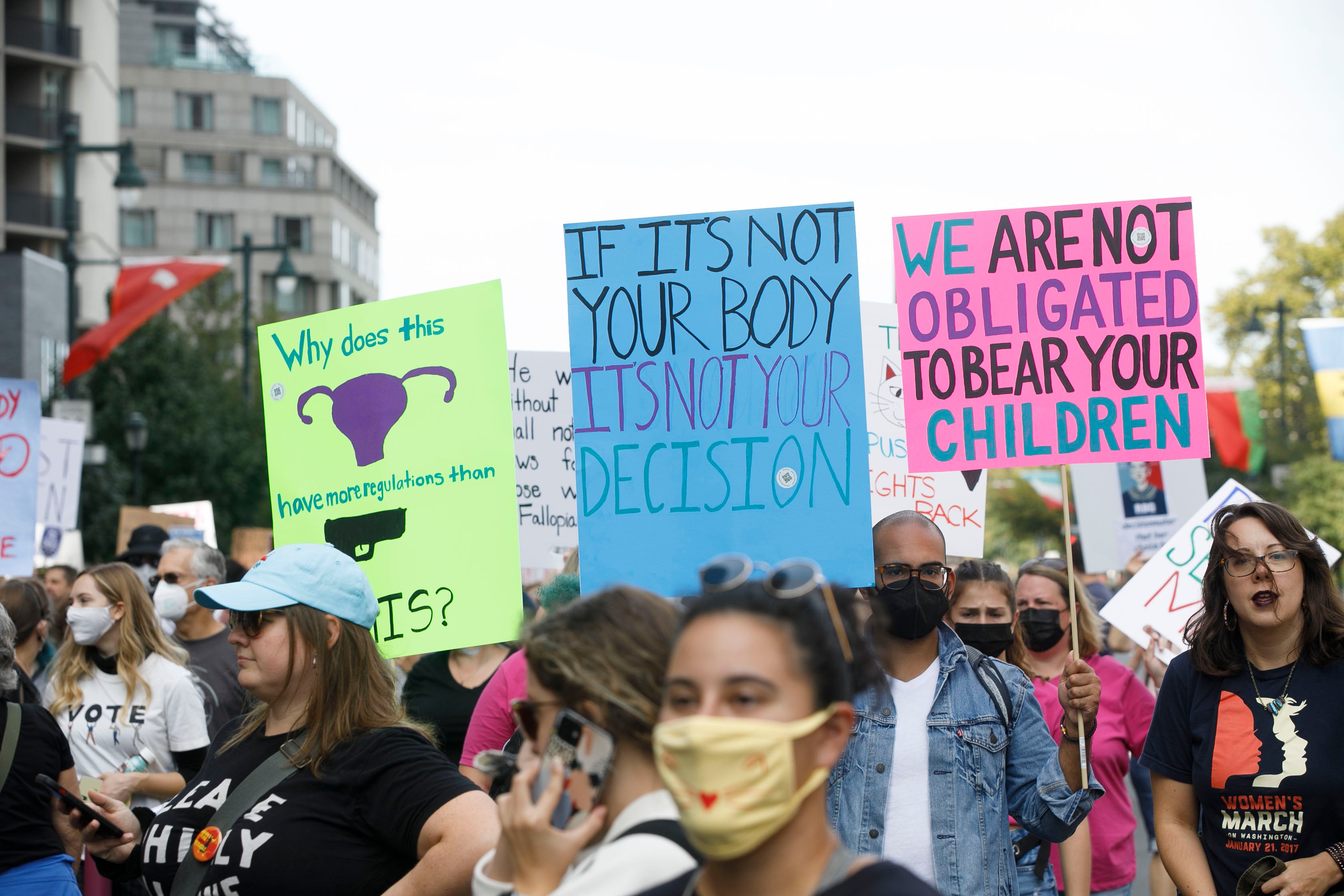
https://whyy.org/articles/about-1000-march-in-philly-as-part-of-national-day-of-support-for-reproductive-rights/
History of Roe v. Wade
First, in order to recognize how visceral the impact of overturning Roe v. Wade has been for practically everyone in the United States- we must understand the history of the case. In 1970, a Texas resident argued that abortion is a constitutional right. After [fighting the case for] almost 3 years, the supreme court decided in favor of “Roe”. According to the Oyez archive,
In the first trimester of pregnancy, the state may not regulate the abortion decision; only the pregnant woman and her attending physician can make that decision. In the second trimester, the state may impose regulations on abortion that are reasonably related to maternal health. In the third trimester, once the fetus reaches the point of “viability,” a state may regulate abortions or prohibit them entirely, so long as the laws contain exceptions for cases when abortion is necessary to save the life or health of the mother.
“Roe v. Wade.” Oyez, www.oyez.org/cases/1971/70-18.
Nearly 50 years later, the right to abortion is not protected and is now deemed illegal in multiple states across the US. With the implementation of Roe v. Wade, women could decide if they wanted to terminate their pregnancy. This law made it possible for women to make decisions about their own bodies.
Truth be told, despite the original ruling, women’s bodies were still being controlled by the government. For instance, a state could deny a woman her right to an abortion after viability. However, with Roe v. Wade, women’s health was somewhat protected. Now in 2022, not only do women no longer have control over their bodies, but every woman’s health is potentially at risk.
Rights under Roe v. Wade
Roe v. Wade protected more than just a woman’s right to terminate her pregnancy. This law protected the right to choose what a woman wanted to do with her body. The risk of pregnancy is extremely high yet one of the least talked about topics. There are a multitude of articles and studies that have shown how dangerous pregnancy can be for a woman. For example, Roe v. Wade medically protected the mother before the unborn fetus. In other words, if there was an instance where the mother and fetus were both in danger either during pregnancy or during birth, the mother would be first to be saved.
Additionally, women could have an ectopic pregnancy. In this case, the egg is displaced in the fallopian tubes rather than the uterus, thus making the fetus not viable. Despite these known facts and many others, the government has overturned a basic constitutional right for all women.
Challenging Privacy Laws
While it’s evident that women are the first and most impacted, the overturning of Roe v. Wade challenges other privacy laws. The case of Griswold v. Connecticut protects the liberty of married couples to buy and use contraceptives without government restriction. With Roe v. Wade being overturned, it is possible that the government may try to control the use of contraceptrives. In this specific instance, all genders are at risk of losing their privacy.
Obergefell v. Hodges is also challenged. This law recognizes the marriage of same-sex couples. Many are concerned that same-sex marriage/relationships could become unlawful as well. The vocabulary used in many arguments surrounding reproductive rights is centered around cisgendered women and their rights. This does nothing to combat the erasure and alienation of trans folks, and the impact this has on their already stigmatized lives. All these laws are intertwined with one another and play a part in protecting individuals’ constitutional rights.
Abortion Laws by State
The overturning of Roe v. Wade effects each state differently. This is because abortion laws vary by state. Certain states that will consider natural miscarriages as abortions. Some states even have a death penalty for those that undergo an abortion or for those that are performing the medical procedure. Below is a map updated in real time of the critical impact of overturning Roe v. Wade.
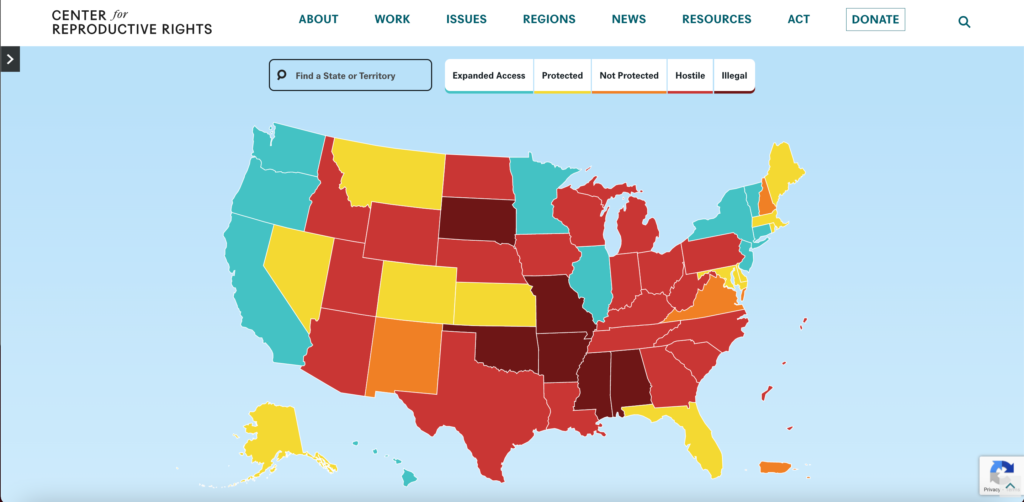
https://reproductiverights.org/maps/abortion-laws-by-state/
According to the map, there are more states where abortion is illegal, hostile, and not protected. Those who recieve abortions in these states would thereafter be considered felons, and as a result, would not be able to vote in future elections. The overturning of Roe v. Wade criminalizes a necessary and life saving procedure, and doing so is restricting even more fundamental rights from women.
How to Help
While it may seem like this is entirely out of your control and you, as an individual, cannot make an impact on how the Supreme Court acts, there are plenty of ways you can contribute. The most important thing is to be sure you are not spreading dis- or misinformation. Before sharing and reposting something through social media, check that the information is coming from a credible source.
This is especially true when it comes to sharing resources for people who are residents of the more conservative states. There have been reports of false posts circulating, claiming to help women in need of abortions, where in fact the creators of these posts are trying to bait women into admitting they were looking for help for an abortion.
Even if you live in a state where access to abortions has not been restricted, donate to Planned Parenthood and trusted local clinics. While they might not be able to perform the procedure on location, the funds help clinics provide patients with the means to receive the help they need.
Resources
Following are some sites you can use to read more about these issues.
Planned Parenthood is a national organization that provides its patients with care regarding all types of reproductive health.
Center for Reproductive Rights is created by lawyers and advocates who provide information on constitutional and international law on reproductive rights.
Status of Women in the States highlights data, statics, and trends of women by state.