Have you ever wondered about the differences between Latino v Latinx and other identity terms that describe people from Spanish-speaking countries or Latin America? It can feel a little confusing, right? Words like Hispanic, Latino, Latina, Latinx, and even Latine are commonly used, and it might make you wonder, “What’s the difference, and why does it matter?” Well, you’re not alone! Understanding these terms and their cultural implications is crucial in today’s discussions about identity, language, and inclusivity. We’re going to take a journey together to understand the history behind these words and how they connect to culture, language, and who we are. By the end of this article, you’ll feel like an expert on Latino v Latinx!
- The Hidden History of the Term Hispanic
- How Gender Reshaped the Latino v Latinx Identity
- How the LGBTQ+ Community Influenced the Conversation
- The Impact of Latino v Latinx on Language
- Unpacking the Data on Latino v Latinx Usage
- Our Identity, Our Choice
Was “Hispanic” Imposed? The Hidden History of How We Got Our Name
Many people use Hispanic interchangeably with Latino or Latinx, but these words have different roots and meanings.

- Hispanic: According to the National Museum of the American Latino, the term Hispanic comes from the Roman name for Spain. So, when we say someone is Hispanic, it often means they have a connection to Spain or Spanish-speaking countries.
Think about it like this: if your family came from Mexico, which speaks Spanish, you might be called Hispanic. People whose families have been in the U.S. for generations but have Spanish-speaking roots might still be considered Hispanic.
Facing History & Ourselves states that the term Hispanic gained prominence in the 1970s when the government needed a way to classify people of Latin American descent in the census. This identification was created by people outside of the Hispanic community as a way to assimilate a marginalized group. Therefore, The Latinx Generation argues that the term Hispanic wasn’t truly representative of Latin American people and needed to evolve.
- Latino and Latina: Latino and Latina describe people with roots in Latin America. This is a bigger group than just Spanish speakers. For example, people from Brazil, where they speak Portuguese, are considered Latino but not Hispanic.
Language as Liberation: How Gender-Neutral Terms Are Reshaping Latino Identity
The shift from Latino to Latinx is part of a broader movement toward gender-inclusive language. In Spanish, as noted by the Real Academia Espanola (RAE), every noun is gendered and ends in “o” for masculine or “a” for feminine. Similar to how “guys” is used to describe a group of people, Latino is used to describe a group of men or a mixed group of men and women. But what about people who do not identify as either male or female? This is where Latino v Latinx emerges as a significant conversation.
- Latinx: According to the Journal of Hispanic Higher Education, Latinx was introduced in 2004 to be more inclusive of everyone, including people who are transgender, non-binary, or gender non-conforming. The “x” is meant to be a neutral ending that doesn’t specify gender. Think of it as a way to say Latino while ensuring inclusivity.
- Latine: Temple University highlights that Latine is another gender-neutral term gaining popularity, especially in Spanish-speaking communities. In Spanish, some words without a specific gender already end in “e.” So, Latine feels more natural to some Spanish speakers.
Using these gender-neutral terms can be a way for people to feel seen and respected for who they are. Despite differing perspectives, the Latino v Latinx discussion is central to modern identity politics.
The Power of Latino v Latinx: How the LGBTQ+ Community Influenced the Conversation
The rise of Latino v Latinx is deeply tied to the LGBTQ+ community. The movement toward gender-neutral language is about inclusivity and representation, but the Journal Committed to Social Change on Race and Ethnicity suggests that the opinion within the community is divided.
- Estudios de Jotería: Some LGBTQ+ individuals feel that Latinx diminishes the hard-won visibility of distinct gender identities, especially trans men or women, adding complexity to the Latino v Latinx debate. This tension and the ongoing desire for identity have contributed to the rise of dialogues and academic explorations, notably within the framework of “Estudios de Jotería” (roughly translated as Queer Studies).
The Latino v Latinx debate highlights the complexity within the LGBTQ+ community and that not every inclusive solution will resonate with everyone in the same way. While Latinx, aims for inclusivity, it also stems from the privilege of those who can navigate and express more fluid or non-binary gender identities.
Beyond Binaries: Understanding the Impact of Latino v Latinx on Language
The Latino v Latinx discussion is about more than just a letter – it represents changing views on language and culture. According to the Chiricú Journal, the use of Latinx is sometimes seen as contributing to “Spanglish,” a blending of Spanish and English. This can feel like an imposition of English linguistic structures onto Spanish, a language with its own rich history and grammatical rules.
- Linguistic Colonization: Historically, linguistic changes have often been driven by dominant cultures. Salinas argues that forcing a term that feels unnatural or difficult within Spanish could be seen as a form of linguistic colonization, echoing past instances where the languages of colonizers were imposed upon subjugated populations.
- Phonetics: The Spanish alphabet does not traditionally include the letter “x” in the way it is used at the end of Latinx to denote neutrality. This creates an awkward or even unpronounceable construction within the natural flow of the language. García-Avello emphasizes the barrier this creates for its widespread use and understanding within Spanish-speaking communities.
Latino v Latinx: Unpacking the Data on Adoption Rates Across Race, Age, and Political Affiliation.
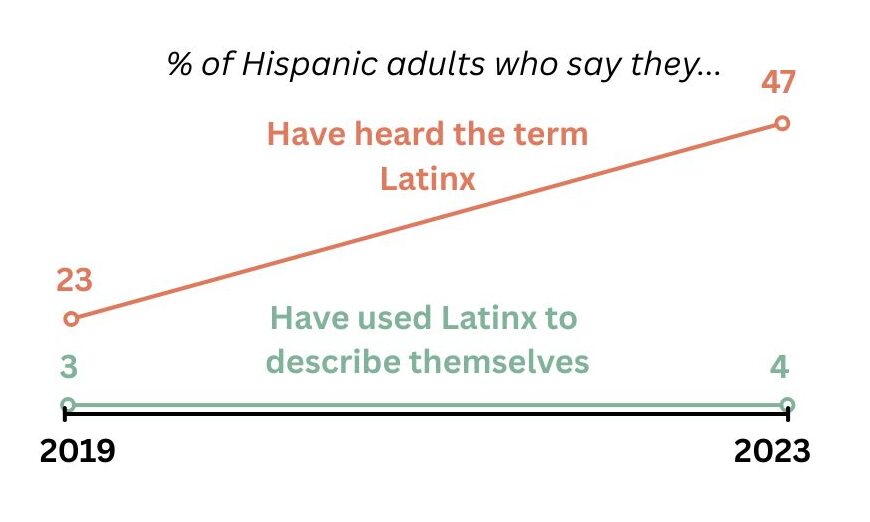
You might be wondering how many people actually use Latino v Latinx in everyday life. Data from a 2023 Pew Research Center survey provides insights into how these terms are adopted across different groups.
- Use of Latinx: While awareness of the term Latinx has increased among U.S. Hispanics since 2019, its actual use remains limited. In 2023, 4% of U.S. Hispanics said they use the term Latinx to describe themselves. This is double the 2% who said the same in a 2019 survey.
- Generational Divide: Pew Research Center points out that younger Hispanics are more likely to be aware of and use Latinx compared to older generations. This is often due to immigration and younger generations assimilating to American culture. In 2023, 7% of Hispanics ages 18 to 29 reported using “Latinx,” compared with 5% of those ages 30 to 49, and 2% of those 50 and older.
- Political Affiliation: Hispanics who identify as Democratic are more likely to use Latinx (6%) than those who identify as Republican (2%).
In terms of other terms, the 2023 survey indicated that Hispanic and Latino continue to be the most widely used terms among U.S. Hispanics. Forty-seven percent prefer the term Hispanic, 29% prefer Latino, and 14% have no preference.

These numbers provide a snapshot in time. However, this data from the Pew Research Center gives us a clearer picture of the current landscape of terminology use within the U.S. Hispanic population.
Conclusion: Our Identity, Our Choice
In the end, the choice between Latino v Latinx is personal, and every individual has the right to define their identity on their own terms. These terms are more than just words – they represent deep issues of cultural identity, gender inclusivity, and personal expression. Whether you choose Latino, Latina, Latinx, or another term entirely, the key is to respect others’ preferences and understand the cultural and historical significance behind these terms.
I believe Latinx should be used as a tool in addition to Latin@, Latino/a, and Latine. Relying solely on Latinx to represent myself and a group of Hispanic and Latin American people feels inauthentic to our collective experiences and does not accurately represent our identities. I believe Latinx is only appropriate when in academia or in an American context. Nonetheless, I believe in its power as a gender-neutral word and support those who claim Latinx as part of their identity.
Regarding my identity, I prefer to refer to myself based on my place of origin: Mexico. Using the place of origin as an identifier avoids gender and allows even more specific identities to emerge. As a Mexican-American, I recognize that my perspective in this discussion is privileged, and my opinion should not define the Latino v Latinx discussion.
By understanding the history and nuances of these terms, you are now better equipped to engage in thoughtful conversations and use inclusive, considerate language. So, how do you identify? Let me know in the comments below!